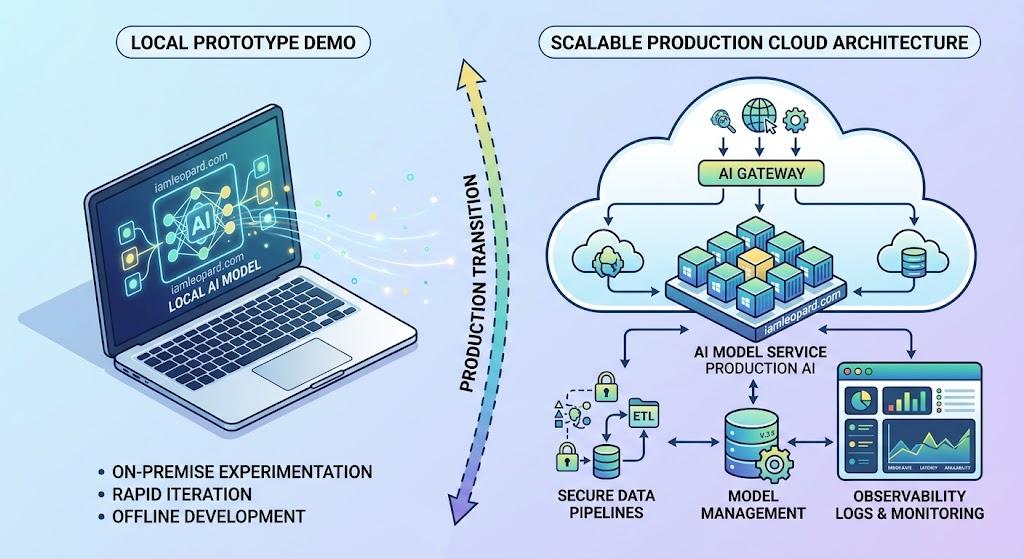
Why most AI pilots never reach production
Moving an AI pilot to production fails for boring reasons, not clever ones. The demo worked on twenty clean examples, one happy user and nobody else's permissions. Production means your real data, your real customers and a monthly bill someone has to approve. Most AI pilots stall in the gap between those two worlds, and the gap is engineering work, not a better model.
The numbers are hard to argue with. IDC and Lenovo followed 33 AI proofs of concept and found that only 4 made it to wide deployment. S&P Global surveyed more than 1,000 companies and found that 42 percent abandoned most of their AI initiatives in 2025, up from 17 percent a year earlier. On average, 46 percent of projects were scrapped somewhere between the proof of concept and broad adoption.
I spend most of my working weeks in that gap, as a forward deployed engineer for small teams. So here is the practical version for a business with 5 to 50 people: what separates a demo from a live feature, how long closing that gap takes, and when a stuck pilot is better killed than finished.
The demo was built to impress, not to last
Nobody sets out to build a fragile pilot. But a pilot is judged in one meeting, so it gets built for that meeting. It runs on a spreadsheet export instead of the live database. The API key sits in a config file. Nobody wrote down what a good answer looks like, so nobody can tell when it gets worse. None of that is a mistake at demo stage. It becomes one the day someone says great, let's roll it out.
The seven gaps between an AI demo and a live feature
Every stalled AI project I have been asked to rescue was missing some mix of the same seven things. The table shows what the demo usually did, what production needs instead, and roughly how long each fix takes for one focused feature.
| Gap | What the demo did | What production needs | Typical effort |
|---|---|---|---|
| Real data | A clean sample or a CSV export | Live data, messy records, missing fields, and a sync that stays current | 1 to 2 weeks |
| Permissions | One admin account sees everything | Each user only reaches what they are allowed to, enforced below the AI layer | 3 to 5 days |
| Evaluation | The founder tried it and liked it | A fixed test set of real questions, scored on every change | 3 to 5 days, then ongoing |
| Cost control | Nobody looked at the token bill | Caching, tight context, per-user limits and a spending alert | 2 to 4 days |
| Failure handling | Assumed the model always answers | Timeouts, retries, a fallback path and a clear I don't know | 2 to 3 days |
| Monitoring | Console logs on a laptop | Logged prompts and outputs, error alerts, usage dashboards | 2 to 3 days |
| Ownership | Lives in one person's head or one vendor's account | Code in your repository, keys in your accounts, a written handover | 2 to 3 days |
Permissions are where AI pilots get dangerous
A demo that answers questions about the customer database is impressive. A live feature that answers any user's question about any customer is a data breach waiting for a curious employee. The fix is to enforce access at the database, not in the prompt. A prompt that says only show this user their own records is a suggestion, and models ignore suggestions under pressure. On the Tryneth backend I put row-level security on 97 of 98 tables for exactly this reason, so the AI agents physically cannot read what the signed-in user cannot.
Evaluation is the gap nobody budgets for
How do you know the new prompt is better than the old one? In most pilots, someone tries three questions and says it feels better. That is fine for a week. It is not fine once customers depend on it. Collect 50 to 200 real questions with known good answers, run them on every change, and track the score. It is dull work. It is also the single habit that separates AI features that improve over time from ones that quietly rot.
A pilot proves the idea can work. Production proves it keeps working on a Tuesday afternoon, with real data, when nobody is watching.
That is the same trap I describe in my piece on why vibe coding is a timebomb: code that looks finished and has never been tested against the real world.
How to take an AI prototype to production in six weeks
For one focused feature (a support assistant, a document extractor, an internal search tool) six weeks is a realistic target when one senior engineer owns the whole thing. Here is the shape I use.
- Week 1, decide what done means. One business metric, such as tickets resolved without a human or hours saved per week. One owner on your side. A written list of what the feature will not do.
- Week 2, connect the real data. Replace the sample with the live source, clean the worst records, and build the sync. This is usually where the first surprise shows up, so it goes early.
- Week 3, lock down access and cost. Database-level permissions, per-user rate limits, prompt caching and a monthly spending cap with an alert.
- Week 4, build the test set. Real questions from real users, scored automatically. Fix the prompt and the retrieval until the score is stable, not until one demo looks good.
- Week 5, soft launch. Release to 10 to 20 percent of users behind a flag, with logging on every call and a one-click rollback.
- Week 6, full rollout and handover. Everyone gets it. Your team gets the documentation, the dashboards and the keys.
What to cut to hit the date
Cut features, never safety. The first production version of an AI feature should do one job well. Multi-step agents, voice, and five integrations can come in version two, once version one has earned trust. Gartner expects more than 40 percent of agentic AI projects to be cancelled by the end of 2027, mostly over cost, unclear value and weak risk controls. Scope creep feeds all three.
What does it cost to finish a stalled AI pilot?
Less than most people fear, and more than the demo cost. A rough rule from my own projects is that production hardening costs one to two times what the demo cost to build. Industry surveys put data preparation alone at 25 to 35 percent of a typical AI integration budget, which matches what I see when the data is messy.
The budget lines to expect
- The build. My AI and automation projects start at $5,000 for a scoped feature. Agencies quoting a small custom AI build usually land between $20,000 and $80,000. See how I scope this under AI and machine learning.
- Model usage. A support assistant answering 1,000 questions a day typically runs $200 to $300 a month in API calls. Without caching and tight context, the same feature can cost three times that. On one production endpoint I cut about 10 million uncached tokens, and the saving showed on the next invoice.
- Maintenance. Budget 15 to 20 percent of the build cost per year for model upgrades, prompt fixes and data changes. Models change underneath you, so this line never goes to zero.
Kill it, fix it, or rebuild it
Not every stuck pilot deserves rescue. Before spending another dollar, sort it into one of three piles.
Kill it when the value was never real
If nobody can name the metric the pilot was meant to move, stop. If the people it was built for have gone back to the old way and nobody complained, stop. A cancelled pilot costs a few thousand dollars. A production feature nobody uses costs that every year.
Fix it when the idea works and the plumbing does not
This is the most common case. Users liked the demo, the answers were mostly right, but it breaks on real data, costs too much or cannot be trusted with permissions. Those are the seven gaps above, and they are all fixable without starting over.
Rebuild it when the foundation is wrong
Some pilots were built inside a no-code tool, a vendor's sandbox or a single notebook that cannot be deployed. If the code cannot live in your own repository and your own cloud account, a clean rebuild is often faster than a migration. Keep the prompts, the test questions and the lessons. Throw away the rest.
Questions people ask about getting AI into production
Why do most AI pilots fail to reach production?
Mostly because the pilot was built to win a meeting, not to run for a year. It used sample data, one admin account and no tests. IDC found only 4 of 33 AI proofs of concept reached wide deployment. The model is rarely the problem. Data, permissions, cost and ownership are.
How long does it take to move an AI pilot to production?
For one focused feature with one senior engineer, about four to eight weeks, and six is a realistic target. Real data integration and building a test set take the most time. If a plan shows nothing live for six months, the scope is too wide. Cut it to one job and ship that first.
What is the difference between an AI proof of concept and a production AI system?
A proof of concept shows the idea can work on a small, clean sample. A production system works on live data for every user, respects permissions, stays inside a budget, handles failures, and is monitored and owned by your team. The model can be identical. Everything around it is different.
How much does it cost to take an AI prototype to production?
Plan on one to two times what the demo cost. With a contract engineer, a scoped AI feature starts around $5,000. Agencies usually quote $20,000 to $80,000 for a small custom build. Add $200 to $300 a month in model usage for a busy assistant and 15 to 20 percent a year for maintenance.
Do I need an in-house AI team to run AI in production?
No. A small business needs one decision maker who owns the metric and a system your team can operate from dashboards and documentation. The engineering can be done on contract, with a retainer for upgrades. What you must own is the code, the cloud accounts and the API keys.
Is your AI pilot stuck at the demo?
If the demo has been almost ready for months, you probably do not need a new idea. You need someone to close the seven gaps. Send me what you have. I will tell you straight whether to kill it, fix it or rebuild it, and what each option costs. See how hiring me works, or start a project today.
Everything I build is listed under services, with the AI work in detail on the AI and machine learning page. The Tryneth case study shows a production AI backend end to end, and my career page covers the rest. When you are ready, get in touch. I answer every message myself.